It is one of the most common methods criminals use to avoid anti-money laundering detection and conceal illicit funds. Breaking up large financial transactions into smaller increments allows criminals to fall below reporting requirements. Hence staying under the radar with their money laundering activities.
Money laundering is referred to as the process of cleaning dirty money by conducting financial transactions. In such a way that its original source and ownership are hidden. Which has been acquired through illegal actions. The criminals should be able to spend their money—money earned through drug trafficking, corruption, fraud, amongst others. Without being detected by the authorities.
Structuring is one of the everyday deceptions used in the laundering of money. Manipulating banking procedures for moving the ill-gotten gain and taking advantage of record-keeping oversight. This article discusses how structuring works, the types of structuring schemes used, and case studies that illustrate how structuring accomplishes money laundering crimes.
Relationship between Structuring and Money Laundering:
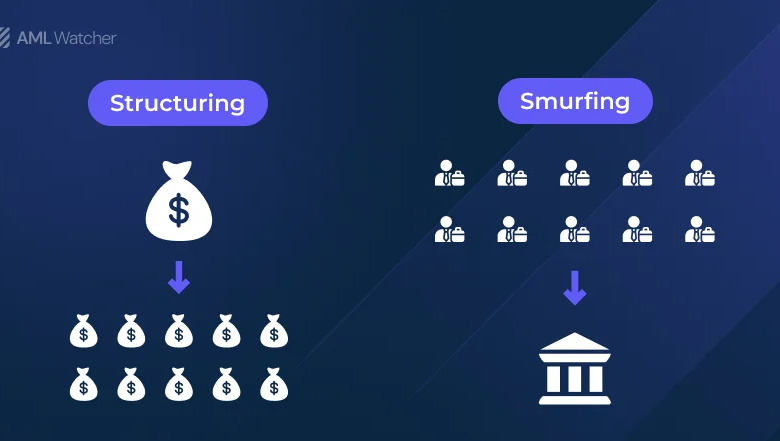
Structuring and smurfing money laundering go hand in hand. Structuring is a scheme used to segment a huge cash transaction into smaller transactions to avoid financial institutions’ reporting rules. This allows criminals to deposit and withdraw illegal money without alerting the authorities to their activities.
Through structuring techniques, criminals can “launder” dirty money by making it appear clean, concealing illegal origins, which is an integral part of how money-laundering networks work.
Common Structuring Techniques:
One of the most common methods used in Examples of Structuring is smurfing. Smurfing is a process by which others, known as “smurfs,”. Deposit or withdraw funds just below the under-reporting limits.
Periodic cash deposits in sums slightly lower than the threshold that would mandate financial institutions to report all transactions over $10,000 were included. As another technique involved with the structuring in money laundering schemes.
Bonus: Through enhanced structuring monitoring programs and information sharing between regulators and financial institutions. As well as continuous risk assessments, the integrity of the financial system can be collectively enhanced much better.
Smurfing:
Smurfing is one of the common methods of structuring. Which criminals do by recruiting others to help them break down large cash transactions into a series of deposits or withdrawals. By doing so, they can deposit or withdraw large amounts of illegally obtained money while avoiding the triggers of currency reporting laws. Which come into effect at $10,000. Structuring through smurfing is an acceptable way to launder money gained from unlawful activities such as drug trafficking and make the funds appear to be lawfully earned.
Below-Threshold Cash Deposits:
Another standard method of structuring that is noticed is that deposits are consistently made below the reporting threshold for anti-money laundering purposes, which is $10,000. Criminals intentionally spread their illegal money over several bank accounts to deposit money in the range of $9,500 several times a day.
In this way, they can bank a high volume of dirty cash without being noticed by the structuring. And anti-money laundering monitoring systems employed by banks. By structuring the transactions in this manner, criminals can successfully launder money. Because it gets mixed with legally earned money.
Periodic Small Withdrawals:
Similar to deposit structuring, criminals will also often make repeated cash withdrawals of less than $3,000. Another critical reporting threshold for financial activity. A series of small withdrawals is an effective method to smurf cash out of an account and avoid structuring in anti-money laundering controls. Moreover, this methodology has been widespread in cases of structuring identified in investigations of money laundering groups that also engage in structuring by smurfing.
Structuring Case Studies Used in Money Laundering Schemes:
One of the most infamous case studies involved a drug trafficking organization that had accrued over $70 million in criminal profits. Additionally, through smurfing and other structuring methods like routine less-than-$10,000 deposits and frequent small withdrawals. This group could deposit and withdraw their crime money without fully alarming the banking system.
This allowed them to launder their narcotics proceeds into several legitimate businesses. The case showed that structuring can facilitate massive money laundering when revenues from substantive criminal fields like drug trafficking are cleaned.
An International Counterfeiting Network:
An organized crime network producing counterfeit notes in Mexico and Europe used structuring to move money across borders and to avoid detection for structuring. This network of individuals deposits millions through many bank accounts. And withdraws their cash in bulk by ‘smurfing’ through the layers of transactions.
Moreover, this depth of structural complexity showed that money emanating from matrix counterfeiting operations is of immense value to criminals. This drives them to get creative with complex schemes to exploit the structuring loopholes that bypass anti-money laundering systems.
Prevent Structuring and Detect Money Laundering:
- Financial institutions must have an effective structuring monitoring program in place. And must file reports of currency transactions and suspicious activity on all transactions reaching thresholds.
- Banks shall provide training for employees to identify some of the more common red flags associated with structuring. Repeated, consistent sub-threshold deposits; multiple daily transactions from one individual totaling over-reporting limits. And deposits by third parties that appear coordinated.
- The banks should have technologies that aggregate transaction data across accounts. And locations to spot structuring that cuts transactions across various accounts in an attempt to avoid structuring in AML detection.
Keep visiting sumosearch for more informative articles.