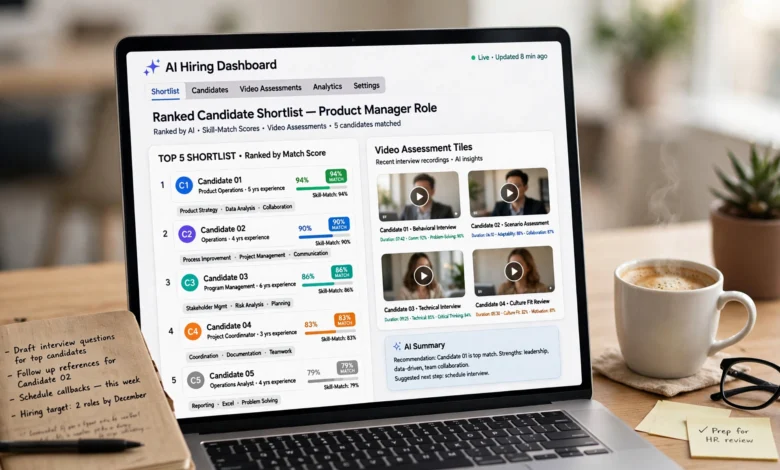
Hiring is slow for a simple reason. Recruiters spend most of their week writing job posts, reading resumes and running the same screening calls, while the actual conversations that close offers get squeezed into whatever time is left. That bottleneck is exactly what flipped ai was built to remove. It is an AI-native recruitment platform that drafts the job post, matches candidates by real skill fit, grades first-round assessments automatically and hands your team a ranked, evidence-backed shortlist.
If you found this guide after searching for flipped ai, you probably want three things: what the platform actually does, who it is built for, and whether reports about it hold up. This article answers all three using the company’s own published material and independent tool directories, and it flags the few points — like current pricing — that you should confirm on the official site before you buy. For more plain-English explainers of the tools businesses actually use, start from the Sumo Search homepage and browse the latest guides.
What Is Flipped AI?
Flipped.ai describes itself as a full-stack recruitment solutions platform. Instead of bolting one AI feature onto a traditional applicant tracking system, it covers the hiring funnel end to end: AI-powered job creation, semantic candidate matching, automated assessments and upskilling, all in one place. The stated goal is that companies hire faster while candidates get discovered on merit — on what they can actually do — rather than on who formatted their resume best.
The company behind the platform is Gaius Networks Inc. According to its official About page, Flipped.ai is headquartered in New York, with its engineering and research center at the IIT Madras Research Park in Chennai, India. That two-continent setup matches the product’s positioning: it is sold to hiring teams that need enterprise-grade screening volume, and it was publicly showcased at Web Summit 2023 in Lisbon as an “AI-powered recruiter” for organizations of all sizes.
The company reports some headline numbers on its own site: more than 500 hiring partners, a 70 percent faster time-to-shortlist and a 94 percent offer-accept rate. Treat those as vendor-reported figures rather than independently audited results — they tell you how the platform positions itself, and they are worth testing against your own hiring data during a trial. What is verifiable is the feature set, and that is where the platform earns its name: it flips the recruiter’s workload from manual screening to reviewing evidence the AI has already organized.
How Flipped AI Works, Step by Step
The workflow follows the same three stages the company lays out on its About page: create the role with AI, auto-screen at scale, then hire from a ranked list. Here is what each stage looks like in practice for a hiring team opening a new role.
- Describe the role. You outline what you need in plain language. The AI drafts a structured job description, extracts the required skills and experience signals, and defines screening criteria automatically.
- Publish and distribute. The finished post goes live on a branded job portal, and third-party directories describe distribution across a network of more than 1,000 job boards, plus engagement through WhatsApp.
- Candidates apply simply. Launch coverage highlighted a one-click application flow, so candidates spend minutes applying instead of fighting long forms.
- AI screens every applicant. Resumes are parsed, and candidates are matched semantically — by skill fit, not just keyword overlap — then ranked against the role’s criteria.
- Assessments grade themselves. Shortlisted candidates complete async video, multiple-choice or voice assessments. The AI grades every response against the same rubric and produces concise candidate summaries.
- Recruiters interview the top of the list. Your team works from a ranked shortlist with analytics on pipeline health and funnel conversion, and spends its time on interviews instead of phone screens.
Two supporting pieces run underneath those steps. A natural-language “hiring co-pilot” lets recruiters ask questions and trigger actions conversationally, and integrations with existing applicant tracking systems mean the platform can sit on top of a stack you already use rather than forcing a rip-and-replace migration.
Key Features at a Glance
The feature list below sticks to capabilities the company and multiple independent directories describe consistently. If a feature matters to your hiring process, it is the checklist to test during a demo.
| Feature | What it does | Why it matters |
|---|---|---|
| AI-assisted job creation | Drafts structured job descriptions and screening questions from a short role brief | Removes hours of writing and keeps every post consistent |
| Semantic candidate matching | Parses resumes and ranks candidates on actual skill fit, not keywords alone | Strong candidates with non-standard resumes stop slipping through |
| Automated assessments | Async video, MCQ and voice assessments graded by AI on one rubric | Every candidate is benchmarked fairly, at any volume |
| Candidate summaries | Turns long resumes into short briefs with key details highlighted | Recruiters review more candidates without missing signals |
| Interview analysis | Analyzes video and voice interviews, including communication signals | Deeper, more consistent evaluation notes for the hiring team |
| Recruiter analytics | Dashboard for pipeline health, source quality, funnel conversion and hiring velocity | Decisions are backed by evidence instead of gut feel |
| Distribution and WhatsApp | Posts roles widely and supports screening chats and assessments inside WhatsApp | Reaches candidates where they already respond fastest |
| Upskilling pipeline | Courses and certifications feed directly into candidate profiles | Candidates who upskill become more discoverable to employers |
Notice what is missing from that table: anything the sources could not confirm. Flipped.ai does not publicly promise, for example, a specific candidate database size in its current About material, so this guide does not invent one. The honest picture is a broad, well-documented feature set whose depth you should validate role by role in a pilot.
Who Uses Flipped AI?
The platform is aimed at the employer side of the market first. HR managers, talent acquisition teams, recruitment agencies and growing companies that post many roles at once get the most from it, because the time savings multiply with volume: one AI-drafted job post saves an hour, but automated screening across thousands of applicants saves whole weeks. Comparison sites list its audience as everyone from tech startups and scaleups to enterprise HR departments and procurement teams evaluating AI hiring tools.
Candidates are the second audience, and the platform’s pitch to them is discovery on merit. A candidate builds a profile, takes skill assessments that create a verifiable benchmark, and gets matched to roles based on demonstrated ability. The upskilling angle reinforces that: courses and certifications are not a side product, they feed the same profile that employers search, so improving your skills directly improves your visibility.
- High-volume employers who need consistent screening across many similar roles.
- Recruitment agencies that must produce quality shortlists for several clients at once.
- Startups and scaleups whose small HR teams cannot afford a long time-to-hire.
- Job seekers who would rather be judged on assessed skills than on resume keywords.
Flipped AI vs Traditional Recruiting
Comparing flipped ai with the traditional, manual process shows where the time actually goes. A conventional funnel is not broken because recruiters are careless; it is broken because its most repetitive steps scale linearly with applicant volume, while an AI pipeline absorbs that volume at a roughly fixed effort.
| Hiring stage | Traditional process | With Flipped.ai |
|---|---|---|
| Job description | Written from scratch or copied from an old post | AI drafts a structured post with skills and screening criteria extracted |
| Resume screening | Manual read-through or blunt keyword filters | Semantic matching ranks every resume by skill fit |
| First-round screening | Recruiter phone screens, one candidate at a time | Async video, MCQ and voice assessments graded by AI on one rubric |
| Shortlist quality | Depends on who happened to review the pile | Ranked list with summaries and analytics behind each pick |
| Decision evidence | Interview notes and gut feel | Assessment benchmarks, interview analysis and funnel metrics |
| Candidate experience | Long forms and long silences | One-click apply, faster feedback, skill-based discovery |
The trade-off to keep in mind is oversight. Automated grading is consistent, but your team still owns the rubric, the criteria and the final call. The platform’s own mission statement — make every hire “faster, fairer, and more evidenced” — only holds if a human reviews the evidence it produces, especially for senior or sensitive roles.
Pricing: What Is Publicly Known
Pricing is the one area where you should be careful with anything you read, including older reviews. When Flipped.ai launched its recruiter platform around Web Summit in November 2023, its press release announced cost-effective plans starting at just $49 per month, with the ability to hire unlimited candidates, and it promoted free job posting credits worth $399 for startups and agencies during the event. That tells you the intended price band at launch: affordable, subscription-based and aimed well below enterprise-only tools.
Current pricing is a different matter. Major software directories list no confirmed current price for the platform, and pricing pages change as products mature. So do not budget from a 2023 press release. Open the official site, check the live plans against the features your team actually needs — assessment volume, distribution reach, integrations — and confirm whether a trial or pilot is available before committing annually.
Getting Started Checklist
If you are evaluating the platform for your team, this sequence keeps the trial honest and comparable against your current process.
- ☐ Pick one real, mid-volume role you are hiring for now as the pilot.
- ☐ Record your current baseline: time-to-shortlist, recruiter hours and offer-accept rate.
- ☐ Draft the job post with the AI and review the extracted skills and screening criteria yourself.
- ☐ Set the assessment rubric before candidates arrive, not after you see the results.
- ☐ Compare the AI-ranked shortlist against a manual review of the same applicants.
- ☐ Check the analytics dashboard weekly: source quality, funnel conversion, hiring velocity.
- ☐ Confirm current pricing, trial terms and ATS integration with the vendor in writing.
That last step matters more than it sounds. AI hiring tools evolve quickly, and the difference between a good pilot and a disappointing one is usually whether expectations — accuracy, volume, support — were pinned down before the subscription started.
Not to Be Confused With Other “Flipped” Products
One honest complication: the name is crowded. Search results for this keyword mix at least three unrelated products, and downloading or buying the wrong one is a real risk. The recruitment platform at flipped.ai, run by Gaius Networks Inc, is the subject of this article and the dominant result for the exact domain name.
The others are different businesses entirely. “Flipped: Chat with AI Character” is an 18+ AI companion and character-chat app distributed through app stores under the flipped.chat brand — entertainment software with no connection to hiring. “Flip” (getflip.com) is an employee app for frontline and deskless workers, and most funding headlines containing the word “Flip” belong to that company, not to Flipped.ai. Finally, “flipped classroom” is a well-known teaching method, which is why some results wander into education. If a page about “Flipped” never mentions job posts, candidates or assessments, you are looking at a different product.
FAQs
What is flipped ai used for?
It is used to run hiring end to end with AI help: drafting job descriptions, distributing posts, matching candidates to roles by skill, grading video, MCQ and voice assessments automatically, and giving recruiters a ranked shortlist with analytics. Employers use it to cut time-to-shortlist; candidates use it to be discovered through assessed skills rather than resume keywords alone.
How much does Flipped.ai cost?
At its November 2023 launch, the company announced plans starting at $49 per month with unlimited candidate hiring. Current pricing is not consistently listed in public directories, and plans change over time, so check the official flipped.ai website for the live price and trial terms before you budget or buy.
Is Flipped.ai the same as the Flipped chat app?
No. Flipped.ai is a business recruitment platform operated by Gaius Networks Inc, headquartered in New York. The “Flipped: Chat with AI Character” app is a separate consumer entertainment product for chatting with AI characters, published under a different brand and developer. The shared word in the name is the only connection.
Conclusion
The appeal of flipped ai is easy to state: it takes the most repetitive parts of recruiting — writing posts, screening resumes, running first-round assessments — and turns them into an automated pipeline that ends in a ranked, evidence-backed shortlist. Its verified feature set covers job creation, semantic matching, AI-graded assessments, interview analysis and recruiter analytics, backed by a company operating from New York and Chennai. Go in with clear eyes on the two soft spots: vendor-reported performance stats and pricing that you must confirm live. Run one honest pilot against your current numbers, and you will know quickly whether the platform earns a permanent place in your hiring stack.