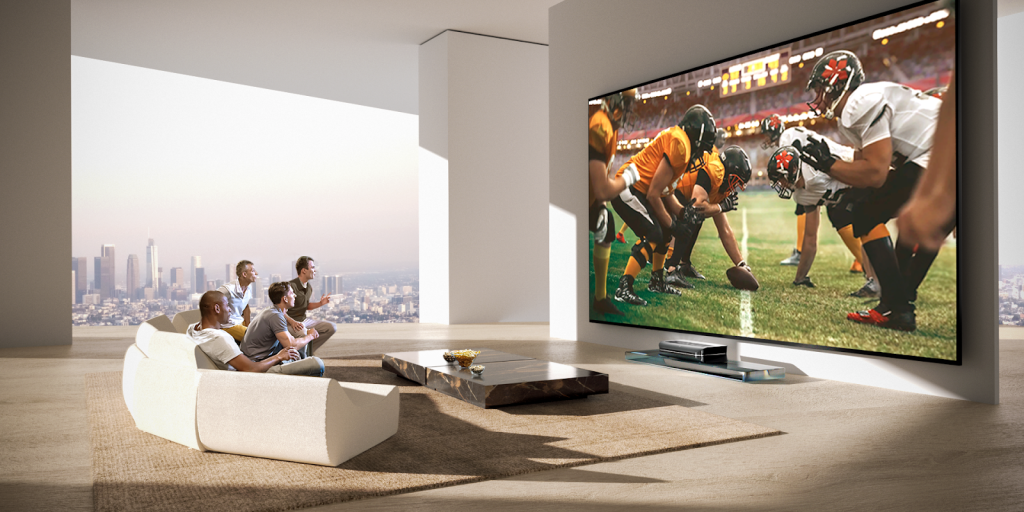
For anyone building a dedicated home theater or a high-end media room, the pursuit of perfection usually travels down two distinct paths: the visual and the audio. Historically, these two disciplines have been at war with one another. Videophiles want the largest, brightest, most uncompromising picture possible. Audiophiles want massive, unencumbered speakers perfectly positioned for an immaculate, three-dimensional soundstage.When you try to combine these two desires in a modern living space, physics gets in the way. As televisions have grown from 55 inches to 85, 98, and even 115 inches, they have created an absolute nightmare for audio reproduction. We have reached a point where the quest for a larger picture is actively destroying the quality of the sound.To understand why this happens—and how modern projection technology offers the only true solution—we have to look at how sound waves interact with the physical objects in your room, and why massive flat panels are the enemy of acoustic harmony.
The Glass Mirror Effect
In the world of acoustics, hard, flat surfaces are the enemy. When sound waves leave your speakers, they don’t just travel directly to your ears in a straight line. They expand outward, bouncing off the walls, the ceiling, the floor, and the furniture.A traditional 85-inch or 100-inch LED or OLED television is essentially a massive, highly reflective pane of glass and rigid plastic. When you place a high-end pair of tower speakers next to a giant television, the sound waves immediately hit the sides of the screen and bounce back into the room. This creates a phenomenon known as “comb filtering” and early reflections. The reflected sound waves collide with the direct sound waves, causing certain frequencies to cancel each other out while amplifying others.The result? A “muddy” sound. The crisp, pristine high notes of a violin or the sharp crack of a snare drum lose their clarity. The soundstage—the illusion that instruments are placed specifically across a three-dimensional space—collapses. The bigger the television, the bigger the acoustic mirror, and the worse the audio degradation becomes.
The Center Channel Dilemma
The acoustic problems of massive TVs become most apparent when we look at the most critical component of any surround sound system: the center channel.In a cinematic audio mix (whether it is 5.1, 7.1, or Dolby Atmos), the center channel does the heavy lifting. Upwards of 70 percent of a movie’s audio—including almost all of the dialogue—is routed exclusively through this single speaker. For the human brain to suspend disbelief, the sound of a character speaking must originate from the exact location of their mouth on the screen.When you mount a 100-inch television on the wall, it takes up almost all the vertical space. You are forced to compromise the placement of your center channel. Usually, it gets shoved down to the very bottom of the media console, inches from the floor, pointing at your shins. Alternatively, it gets mounted high up near the ceiling, pointing down at your head.This creates a massive visual-audio disconnect. You see an actor speaking at eye level, but the voice sounds like it is coming from the floorboards. The immersion is instantly broken.
Reclaiming the Soundstage with Projection
This acoustic bottleneck is exactly why audio purists and dedicated home theater designers turn to projection. By removing the massive glass mirror from the front wall, you instantly reclaim control over your room’s acoustics.When you project an image, you are replacing a hard, reflective television panel with a softer, tensioned surface. Upgrading your visual setup with a dedicatedprojector screen inherently improves the acoustic properties of the room. The fabric and specialized optical materials used in high-quality screens do not bounce high-frequency sound waves around the room with the same aggressive, chaotic energy as a glass panel.Furthermore, the physical footprint of the technology changes the geometry of your setup. Modern Ultra Short Throw (UST) laser projectors sit on a low-profile console. Because the image is projected upward, it leaves the space immediately below the image entirely free for a massive, uncompromised center channel speaker. You can align the tweeters perfectly with ear-level seating, anchoring the dialogue exactly where it belongs without the sound bouncing off a screen above it.
The Ultimate Fix: Acoustically Transparent Materials
For the ultimate, no-compromise home theater, projection allows for a technique used in commercial cinemas: Acoustic Transparency (AT).With a traditional “long throw” projector setup, you can utilize a woven AT screen. This material features thousands of microscopic perforations that allow sound waves to pass through the screen without degrading the audio quality or the video resolution.This unlocks the holy grail of speaker placement. You can physically hide your left, right, and center channel speakers behind the screen. The dialogue comes directly from the actors’ mouths. The soundstage matches the visual scale perfectly. The massive speakers vanish from the room, leaving only a clean, minimalist aesthetic and an immense wall of sound and picture. You physically cannot do this with a television.
Harmonizing Sight and Sound
Building a luxury media room is an exercise in balance. There is no point in investing thousands of dollars in high-fidelity amplifiers, tower speakers, and subwoofers if the display technology is going to sabotage the acoustics.When you decide toshop movie projectors to anchor your living room or dedicated theater, you are making a conscious decision to prioritize both senses equally. You are choosing a technology that delivers a massive, 120-inch cinematic visual without forcing your audio system to fight against a giant pane of reflective glass.True immersion is fragile. It requires the perfect, seamless integration of what you see and what you hear. By moving beyond the limitations of flat panels and embracing projection, you allow your high-end audio to finally breathe, creating a harmonious, theater-grade experience right in your home.